Te Rotorua-nui-a-Kahumatamomoe (Te Rotorua-nui-a-Kahumatamomoe)
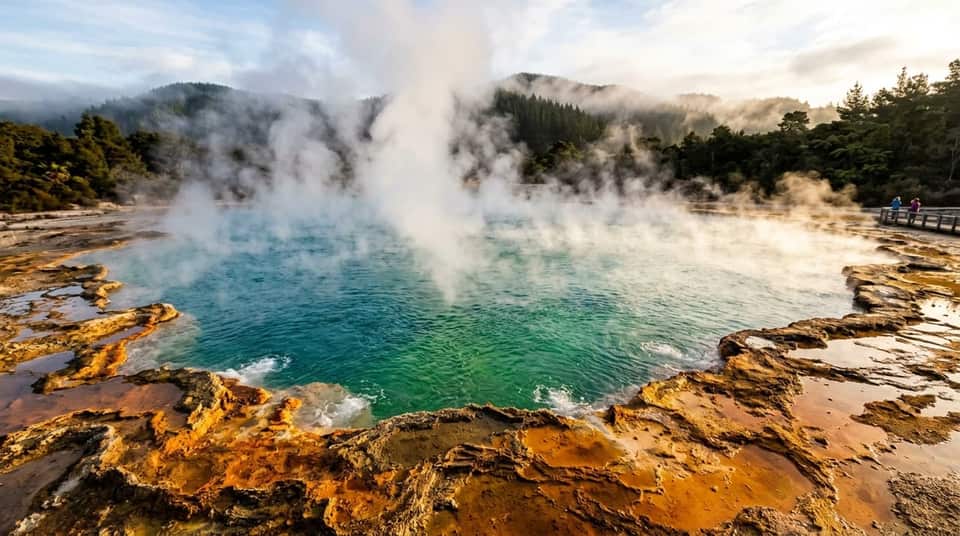
Steaming primordial earth of emerald craters, ochre terraces & geysers
Nordinsel · 2 rā · GPS: -38.3592, 176.3686
Te Reo Māori: Rotorua · Wai-O-Tapu (Raw-taw-roo-ah · Why-aw-tah-poo · /ɾɔtɔˈɾua waiɔˈtapu/) — Second great lake & sacred geothermal waters
Region: Te Arawa & Central Volcanic Plateau (Te Arawa & Tūwharetoa · Living Earth)
Te Kōrero o tēnei Wāhi
Here you feel Earth’s pulse right beneath your boots. Around Rotorua and Wai-O-Tapu, plumes of white steam curl from bubbling mud pools and vivid mineral springs—crowned by the emerald waters and glowing orange silica rim of the Champagne Pool.
Sitting atop the active Taupō Volcanic Zone, Rotorua reminds you with every breath how thin Earth’s crust lies here. Plumes of steam rise from parks and lakeshores framed by lush native forest.
Thirty minutes south, Wai-O-Tapu—“Sacred Waters”—displays nature’s full geothermal palette of neon pools, ochre silica terraces, and the continuously fizzing Champagne Pool.
Ngā Taipitopito Wāhi
- Teitei me te Āhuarangi
- 280–390 m above sea level · Warm geothermal & mineral-rich
- Kaupeka Pai Rawa
- Year-round · May – Sept. (thickest steam)
- Āhua o te Whenua
- Geothermisch, Vulkanisch
- Te Wā Whakamīharo
- Stepping across wooden boardwalks wrapped in warm sulfur mist at morning until the veil parts to reveal the steaming, orange-rimmed Champagne Pool.
- Mārama Pai Rawa me te Whakaahua
- Early morning in cool, clear air when steam columns rise thickest and low sunlight backlights the vapor in gold.
- Te Ara me te Ahunga
- Roughly 3 hours south of Auckland via SH1 and SH5; Wai-O-Tapu sits 27 km south of Rotorua toward Taupō.
Ngā Rongo o te Wāhi
Rhythmic bubbling of thermal mud pools & deep hissing from steaming fumaroles
Warm mineral steam on the skin, crisp sulfur & damp mānuka scrub
72% volcanic rawness (72%)
Ngā Tohutohu me ngā Kōrero Huna
- Arrive at Wai-O-Tapu for the 8:30 a.m. opening before mid-morning tour buses arrive.
- Pair daytime craters with an evening Māori cultural experience featuring hāngī earth-oven dining.
- A twilight stroll among the towering trunks and suspended bridges of the Redwood Forest makes a serene finish.
Behind the Postcard & Tiaki
Rotorua verkörpert sowohl gelebte Māori-Gastfreundschaft (Manaakitanga) und die Stärkung von Te Reo Māori als auch den sozialen Kontrast zwischen weltbekannten Geothermalparks, Wohnungsengpässen vor Ort und Debatten über faire Teilhabe im Rahmen von Te Tiriti o Waitangi.
Te Tiriti & Indigene Rechte
Buche direkt bei authentischen, Iwi- und Whānau-geführten Kultur- und Thermalprojekten, damit Wertschöpfung und kulturelle Deutungshoheit in den Händen der Gemeinden vor Ort bleiben.
Ngā Huarahi e pā ana ki tēnei Wāhi
- Culture, Myth & Middle-earth — Sacred Māori sites, geothermal earth forces & cinematic worlds
- Families & Relaxed Explorers — Gentle trails, golden coves, and natural wonders without rush
- Car-Free Aotearoa (Hop-on Hop-off Classic) — 21 days from Pacific bays to Fiordland — 100% by bus pass, ferry & day shuttles
FAQ
E hia ngā rā mō Te Rotorua-nui-a-Kahumatamomoe, ā, āhea te kaupeka pai rawa?
E tūtohutia ana kia 2 rā ki Te Rotorua-nui-a-Kahumatamomoe. Ko te wā pai ko Year-round · May – Sept. (thickest steam); ko te mārama pai rawa: Early morning in cool, clear air when steam columns rise thickest and low sunlight backlights the vapor in gold..
Kei hea a Te Rotorua-nui-a-Kahumatamomoe i Aotearoa, ā, he pēhea te āhuarangi?
Kei te rohe o Te Arawa & Central Volcanic Plateau (Nordinsel, GPS: -38.3592, 176.3686), teitei 280–390 m above sea level, āhuarangi Warm geothermal & mineral-rich.
Me pēhea te whakahua i a Te Rotorua-nui-a-Kahumatamomoe?
Ko te whakahuatanga ko “Raw-taw-roo-ah · Why-aw-tah-poo” (IPA: /ɾɔtɔˈɾua waiɔˈtapu/) — Second great lake & sacred geothermal waters.