Whanganui River & Bridge to Nowhere (Te Awa Tupua)
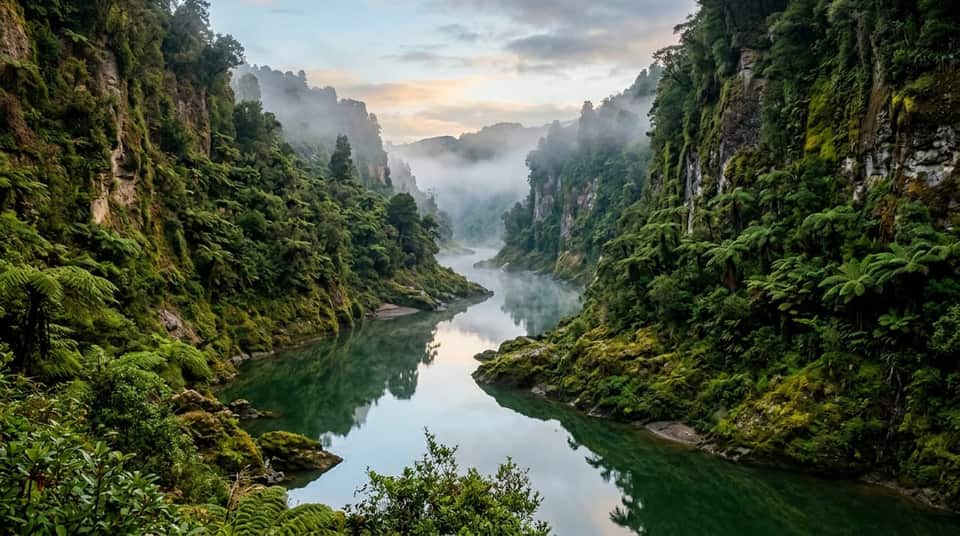
A sacred rainforest river protected with legal personhood amid tree-fern gorges
Nordinsel · 2 dias · GPS: -39.2708, 174.9286
Te Reo Māori: Whanganui · Te Awa Tupua (Fah-ngah-noo-ee · Teh Ah-wah Too-poo-ah · /faŋaˈnui/) — Great harbour & ancestral river with legal personhood
Region: Taranaki & Whanganui River (Te Maunga o Taranaki & Te Awa Tupua · Sacred Cone & Living River)
Retrato deste lugar sagrado
Carved deep through a vast sea of untouched lowland rainforest, the Whanganui winds silently toward the Tasman Sea—the first river on Earth granted the legal rights of a living person. Between mossy sandstone walls, misty side creeks, and the enigmatic Bridge to Nowhere deep in the bush, modern time dissolves.
In 2017 New Zealand made legal history when the Te Awa Tupua Act recognized the Whanganui River—from mountain source to sea—as a living, indivisible entity with full legal personhood. Paddling its quiet reaches or tracing the winding Whanganui River Road quickly reveals why local iwi say: “Ko au te awa, ko te awa ko au—I am the river, and the river is me.”
Deep inside the national park stands the haunting 1936 concrete Bridge to Nowhere spanning a mossy fern gorge without a road in sight—a testament to rainforest reclaiming abandoned pioneer valleys.
Ficha do destino
- Altitude e Clima
- 50–320 m (river gorge) · Mist-veiled & sheltered subtropical
- Melhor época
- October – April (calm canoe stages)
- Cenário natural
- Regenwald, Hügelland
- O seu momento inesquecível aqui
- Gliding by canoe through rising dawn river mist without a single engine sound as tūī and bellbird songs echo off both canyon walls.
- Melhor luz e fotografia
- Just after sunrise in the deep gorges near Pipiriki as golden beams part the mist above mirror-calm water.
- Acesso e Orientação
- Pipiriki sits roughly 1 hour southwest of Ohakune (Tongariro) or 1.5 hours upriver north of Whanganui.
Impressões sensoriais no local
Silent wooden paddle strokes & echoing chorus of tūī and bellbirds in deep gorges
Cool rising river mist, mossy sandstone cliffs & ancient lowland fern forest
96% sacred river hush (96%)
Segredos locais e dicas
- Drive the winding scenic Whanganui River Road between Pipiriki and Whanganui, pausing at historic Jerusalem (Hiruhārama).
- Reach the Bridge to Nowhere via jet boat from Pipiriki plus a 40-minute rainforest walk—or on a multi-day canoe journey.
- Early mornings bring atmospheric valley mist drifting silently through the narrow sandstone gorges near Ātene.
FAQ
Quantos dias reservar para Whanganui River & Bridge to Nowhere e qual é a melhor época?
Recomendam-se 2 dias em Whanganui River & Bridge to Nowhere. A melhor temporada é October – April (calm canoe stages), com luz especial em: Just after sunrise in the deep gorges near Pipiriki as golden beams part the mist above mirror-calm water..
Onde fica Whanganui River & Bridge to Nowhere na Nova Zelândia e como é o clima?
Whanganui River & Bridge to Nowhere localiza-se na região de Taranaki & Whanganui River (Nordinsel, GPS: -39.2708, 174.9286), com altitude 50–320 m (river gorge) e clima Mist-veiled & sheltered subtropical.
Como pronunciar Te Awa Tupua em Te Reo Māori?
Te Awa Tupua pronuncia-se “Fah-ngah-noo-ee · Teh Ah-wah Too-poo-ah” (AFI: /faŋaˈnui/) e significa: Great harbour & ancestral river with legal personhood.