Franz Josef Glacier (Kā Roimata o Hine Hukatere)
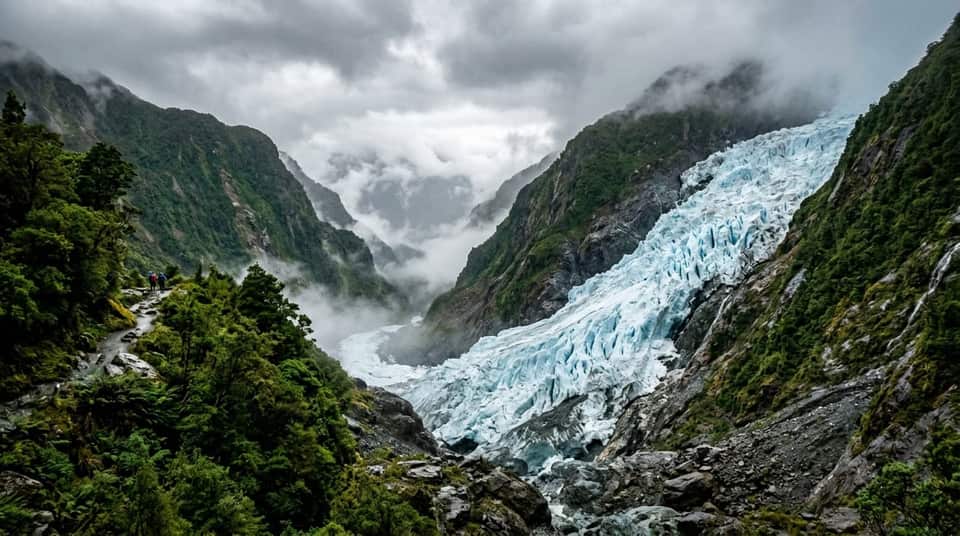
Where ancient sapphire glacier ice meets lush temperate rainforest
Südinsel · 2 days · GPS: -43.4333, 170.1833
Te Reo Māori: Kā Roimata o Hine Hukatere (Kah Roy-mah-tah aw Hee-neh Hoo-kah-teh-reh · /kaː ˈɾɔimata ɔ ˈhinɛ hukaˈtɛɾɛ/) — The frozen tears of Hine Hukatere
Region: Wild West Coast & Alpine Passes (Te Tai Poutini · Greenstone Coast, Rainforest & Glaciers)
Portrait of This Sanctuary
Along the wild West Coast, nature stages a rare contrast: a steep river of electric-blue glacier ice cascades straight down from Southern Alps snowfields toward valleys draped in tree ferns and moss.
Nowhere else in the Southern Hemisphere do lush rainforest and sapphire glacier ice collide so closely as in Westland Tai Poutini. Tree ferns and mossy rātā frame a wide glacial valley leading toward Kā Roimata o Hine Hukatere.
Even on misty West Coast days, low cloud drifting across dark slate cliffs imbues this valley with primeval drama.
Destination Dossier
- Elevation & Climate Feel
- 250–1,500 m above sea level · Cool, humid & mist-veiled
- Best Season
- October – April (clearer West Coast windows)
- Signature Scenery
- Gletschereis, Regenwald
- Your Goosebump Moment
- Standing deep in the valley listening to distant ice creaks while rainforest mist drifts softly across steel-blue seracs.
- Best Light & Photography Tip
- Under bright overcast skies or crisp morning light, when dense glacier ice glows deepest steel blue.
- Arrival & Orientation
- Along West Coast Highway (SH6), roughly 5 hours south of Greymouth or 3.5 hours northwest of Wanaka.
Sensory Impressions On Site
Distant cracking of ancient glacier ice & roaring glacial meltwater streams
Chilled ice breeze, fine West Coast mist & damp silver-fern moss
91% pure wilderness (91%)
Local Secrets & Field Notes
- Build an extra buffer day into your itinerary in case coastal cloud pauses helicopter flights.
- Peters Pool and Sentinel Rock offer gorgeous reflections and valley vistas on foot.
- Drive 30 minutes at dawn to Lake Matheson for mirror reflections of Aoraki and Mount Tasman.
Behind the Postcard & Tiaki
Kaum ein Ort macht die Erderwärmung sichtbarer als Kā Roimata o Hine Hukatere: Der dramatische Gletscherrückgang macht geführte Eistouren fast nur noch per Helikopter möglich – ein echtes ökologisches Dilemma zwischen Lärm, Emissionen und wirtschaftlichem Überleben des Talorts.
Klimawandel & Ökologie
Bevorzuge ausgedehnte Tal- und Regenwaldwanderungen mit zertifizierten lokalen Naturführern, füttere niemals den bedrohten Bergpapagei Kea und unterstütze regionale Schutzprojekte.
Dream Routes Featuring This Stop
- Outdoor & Adrenaline — Volcanic ridges, sea kayaks, glacier ice, and alpine peaks
- Car-Free Aotearoa (Hop-on Hop-off Classic) — 21 days from Pacific bays to Fiordland — 100% by bus pass, ferry & day shuttles
FAQ
How many days do you need for Franz Josef Glacier and when is the best time to visit?
Plan 2 days for Franz Josef Glacier. The best season is October – April (clearer West Coast windows), with standout photography and atmosphere during: Under bright overcast skies or crisp morning light, when dense glacier ice glows deepest steel blue..
Where is Franz Josef Glacier located in New Zealand and what is the climate like?
Franz Josef Glacier sits in the Wild West Coast & Alpine Passes region (Südinsel, GPS: -43.4333, 170.1833) with 250–1,500 m above sea level and a Cool, humid & mist-veiled profile.
How do you pronounce Kā Roimata o Hine Hukatere in Te Reo Māori and what does it mean?
Kā Roimata o Hine Hukatere is pronounced "Kah Roy-mah-tah aw Hee-neh Hoo-kah-teh-reh" (IPA: /kaː ˈɾɔimata ɔ ˈhinɛ hukaˈtɛɾɛ/). Meaning: The frozen tears of Hine Hukatere.