Curio Bay & Cathedral Caves (Tumu Toka & Waipati)
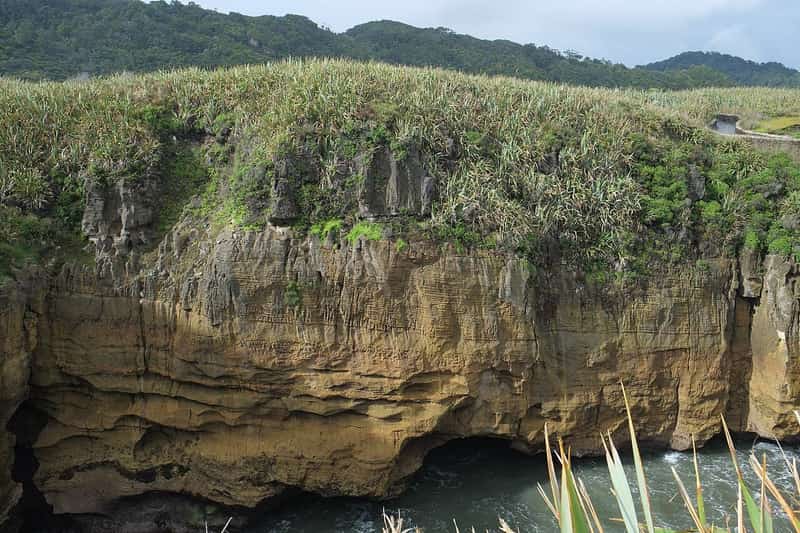
A 180-million-year-old Jurassic petrified forest washed by waves alongside soaring sea caverns
Südinsel · 1 day · GPS: -46.6150, 169.1050
Te Reo Māori: Tumu Toka · Waipati (Too-moo Taw-kah · Why-pah-tee · /ˈtumu ˈtɔka/) — Petrified tree stumps (Curio Bay)
Portrait of This Sanctuary
At low tide on Curio Bay’s rocky shelf, fossilised logs and stumps of a Jurassic Gondwana forest lie exposed right in the surf zone, where rare yellow-eyed penguins (hoiho) hop ashore at dusk and Hector’s dolphins surf adjacent Porpoise Bay. Nearby, Waipati Beach’s Cathedral Caves soar thirty metres high.
Few coastlines anywhere unite deep geological time and wild marine life like twin Curio Bay (Tumu Toka) and Porpoise Bay: at low tide, a wave-cut shelf reveals the fossilised stumps and fallen logs of a 180-million-year-old Jurassic Gondwana forest.
Summer swells next door at Porpoise Bay often host playful Hector’s dolphins, dusk brings rare yellow-eyed penguins ashore across the shelf, and twenty minutes north soar the 30-metre sea caverns of Cathedral Caves at Waipati Beach.
Destination Dossier
- Elevation & Climate Feel
- Sea level · Wild Southern Scenic coast & crisp surf
- Best Season
- November – April (dolphins in Porpoise Bay & low-tide cave access)
- Signature Scenery
- Steilküste, Pazifikstrand
- Your Goosebump Moment
- Tracing fossil wood grain 180 million years old at low tide while tiny Hector’s dolphins ride turquoise rollers in neighbouring Porpoise Bay.
- Best Light & Photography Tip
- Golden hour before sunset at Curio Bay cliff lookout, or low tide in morning light inside Cathedral Caves.
- Arrival & Orientation
- 1 hour east of Invercargill or 45 minutes southwest of Owaka on the Southern Scenic Route.
Sensory Impressions On Site
Waves washing across 180-million-year-old Jurassic petrified logs & echoes inside 30-metre sea caves
Tide-wet fossilised tree rings underfoot, bull-kelp scent & Hector’s dolphins surfing close to shore
95% Jurassic petrified coast (95%)
Local Secrets & Field Notes
- Check daily low-tide gate opening hours before driving to Cathedral Caves (open roughly two hours around low tide).
- At dusk in Curio Bay, watch returning hoiho penguins strictly from the elevated viewing platform so birds come ashore undisturbed.
- Walk the short Living Forest loop beside the cliffs to see modern descendants of the Jurassic trees below.
FAQ
How many days do you need for Curio Bay & Cathedral Caves and when is the best time to visit?
Plan 1 day for Curio Bay & Cathedral Caves. The best season is November – April (dolphins in Porpoise Bay & low-tide cave access), with standout photography and atmosphere during: Golden hour before sunset at Curio Bay cliff lookout, or low tide in morning light inside Cathedral Caves..
Where is Curio Bay & Cathedral Caves located in New Zealand and what is the climate like?
Curio Bay & Cathedral Caves sits in the Dunedin, Otago Peninsula & The Catlins region (Südinsel, GPS: -46.6150, 169.1050) with Sea level and a Wild Southern Scenic coast & crisp surf profile.
How do you pronounce Tumu Toka & Waipati in Te Reo Māori and what does it mean?
Tumu Toka & Waipati is pronounced "Too-moo Taw-kah · Why-pah-tee" (IPA: /ˈtumu ˈtɔka/). Meaning: Petrified tree stumps (Curio Bay).