Aoraki / Mount Cook (Aoraki)
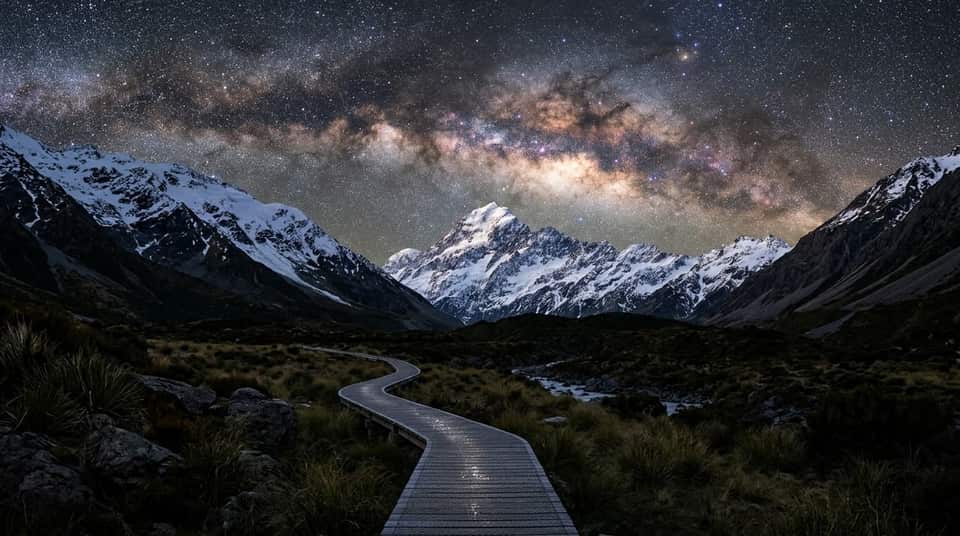
Beneath the clearest southern night sky before the Cloud Piercer
Südinsel · 2 days · GPS: -43.7333, 170.0961
Te Reo Māori: Aoraki (Ow-rah-kee · /aoˈɾaki/) — Cloud piercer (highest mountain in Aotearoa)
Region: Mackenzie High Country & Aoraki (Te Manahuna · Golden Tussock & Dark Sky Sanctuary)
Portrait of This Sanctuary
Rising 3,724 meters, Aoraki—“the Cloud Piercer”—towers above the Hooker Valley. By day suspension bridges cross milky glacier rivers toward ice-clad cliffs; by night the Aoraki Mackenzie Dark Sky Reserve becomes a cosmic cathedral.
Driving alongside milky-turquoise Lake Pukaki ranks among the finest stretches of road anywhere in the southern hemisphere as Aoraki rises higher with every bend.
From the alpine village, the Hooker Valley Track crosses three swing bridges to an iceberg-dotted glacial lake—and after sunset, the Aoraki Mackenzie Dark Sky Reserve unveils millions of razor-sharp stars.
Destination Dossier
- Elevation & Climate Feel
- 760–3,724 m (Hooker Valley) · Crystal-clear & crisp high alpine
- Best Season
- March – May & Sept. – Nov. (clearest nights)
- Signature Scenery
- Hochalpin, Gletschereis, Sternenhimmel
- Your Goosebump Moment
- Standing in utter silence beside Hooker Lake at midnight watching the Milky Way arch over snow-covered peaks so clearly you feel you could touch it.
- Best Light & Photography Tip
- At sunrise for pink alpenglow on the summit—and after dark for world-class astrophotography.
- Arrival & Orientation
- About 3 hours north of Queenstown or 4 hours southwest of Christchurch via SH80 along Lake Pukaki.
Sensory Impressions On Site
Vast alpine stillness broken only by distant avalanches high on the ice faces
Razor-crisp glacier air & frost-clear night sky over Hooker Valley
97% pure wilderness (97%)
Local Secrets & Field Notes
- Walk Hooker Valley or Tasman Glacier Viewpoint early or late in the day for side-lit peaks.
- Step outside after midnight to spot the Magellanic Clouds and southern Milky Way.
- Stock up on groceries in Twizel or Tekapo beforehand as village options are limited.
Behind the Postcard & Tiaki
Rund um Aoraki / Mount Cook schrumpfen die großen Talgletscher rasant, während steigende Besucherzahlen im engen Hooker Valley und Rundflug-Verkehr das hochsensible alpine Ökosystem und das Dark-Sky-Reservat herausfordern.
Klimawandel & Ökologie
Erkunde das Tal zu Fuß im ruhigen Morgen- oder Abendlicht, nutze das Aoraki-Besucherzentrum für kulturellen Ngāi-Tahu-Kontext, schütze den Kea durch sicheren Abstand und vermeide unnötiges Außenlicht bei Nacht.
Dream Routes Featuring This Stop
- First-Timers & Classics — From the farthest northern cape to the granite fjords of the south
- Photographers & Slow Travelers — Chasing dawn light, fjord mist, and the southern Milky Way
- South Island Without Left-Hand Driving (Bus & Rail) — 14 days of Southern Alps, Dark Sky, fiords & whales — completely car-free
FAQ
How many days do you need for Aoraki / Mount Cook and when is the best time to visit?
Plan 2 days for Aoraki / Mount Cook. The best season is March – May & Sept. – Nov. (clearest nights), with standout photography and atmosphere during: At sunrise for pink alpenglow on the summit—and after dark for world-class astrophotography..
Where is Aoraki / Mount Cook located in New Zealand and what is the climate like?
Aoraki / Mount Cook sits in the Mackenzie High Country & Aoraki region (Südinsel, GPS: -43.7333, 170.0961) with 760–3,724 m (Hooker Valley) and a Crystal-clear & crisp high alpine profile.
How do you pronounce Aoraki in Te Reo Māori and what does it mean?
Aoraki is pronounced "Ow-rah-kee" (IPA: /aoˈɾaki/). Meaning: Cloud piercer (highest mountain in Aotearoa).